
How to set task due date in Uku
This content is not available in your language yet.
Due dates work differently depending on the task type. Single tasks use simple calendar-based deadlines. Recurring tasks can calculate due dates dynamically based on the billing period or task start date, with flexible options for handling weekends and public holidays.
Who can do this
Section titled “Who can do this”- Any team member with permission to create or edit tasks.
- Members with access to task templates or client Workflows.
Setting due dates for single tasks
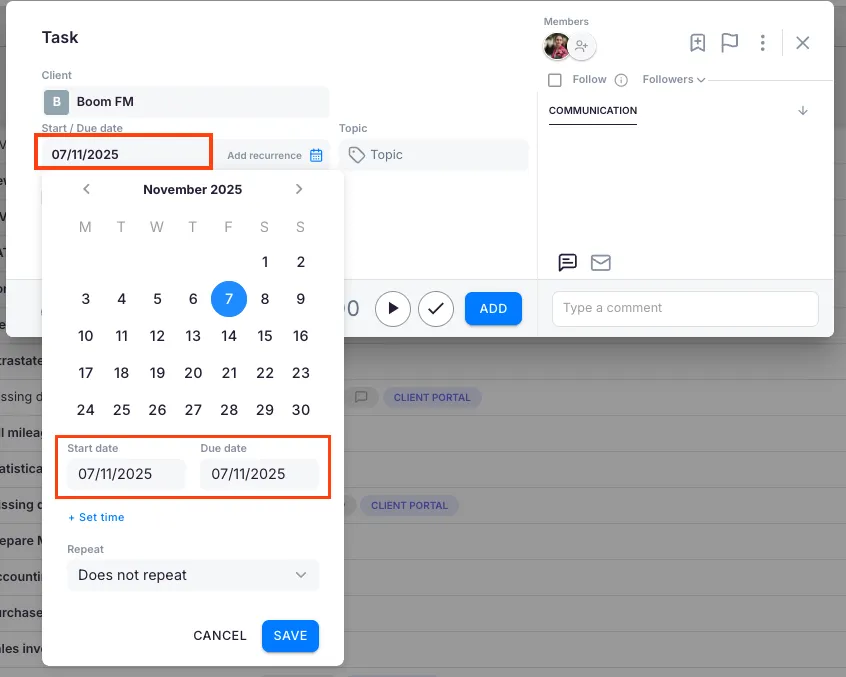
Section titled “Setting due dates for single tasks”- Create or open a task.
- Click the Due date field.
- Select your desired date from the calendar, or type the date manually.
- Optionally, add a specific time for the deadline.
- Save the task.
Setting due dates for recurring tasks
Section titled “Setting due dates for recurring tasks”Monthly recurrence due dates
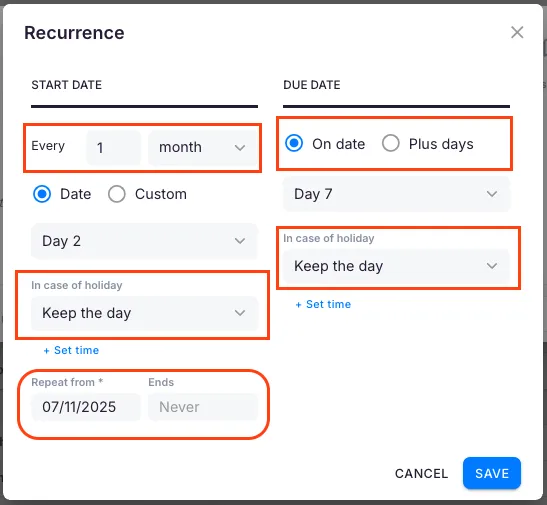
Section titled “Monthly recurrence due dates”Monthly recurring tasks offer the most flexibility for accounting work.
Option A: Specific date
- Select a day of the month (e.g., the 15th).
- Choose behavior for weekends and holidays: Before (move earlier), After (move later), or Exact (keep the date).
Option B: Plus days calculation
- Set the due date as a number of working days after a reference point.
- Choose the reference point: From start of task or From beginning of month.
- Select which days to count: Monday to Friday excluding public holidays (most common), Monday to Friday including public holidays, or all calendar days.
Example: For VAT return tasks due 20 business days after month-end, set recurrence as monthly, then choose From beginning of month with 20 days using Monday to Friday, excluding public holidays.
Weekly recurrence due dates
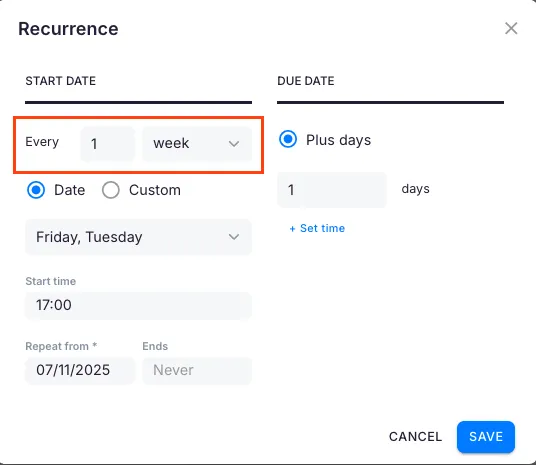
Section titled “Weekly recurrence due dates”- Set the day of the week for the task.
- Optionally add a specific time for the deadline.
Quarterly recurrence due dates
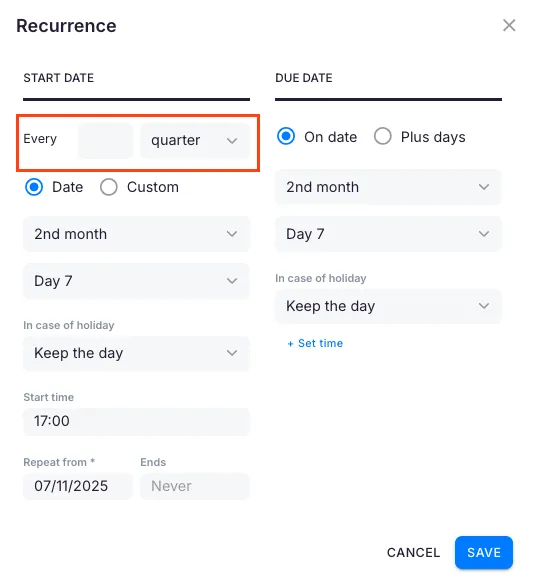
Section titled “Quarterly recurrence due dates”- Choose which month of the quarter the due date falls in (first, second, or third).
- Select a calculation method: specific date with before/after day-off rules, or plus days from start date or beginning of quarter.
Annual recurrence due dates
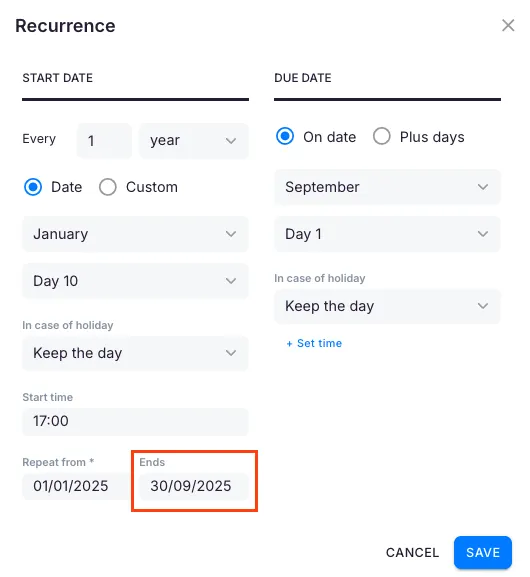
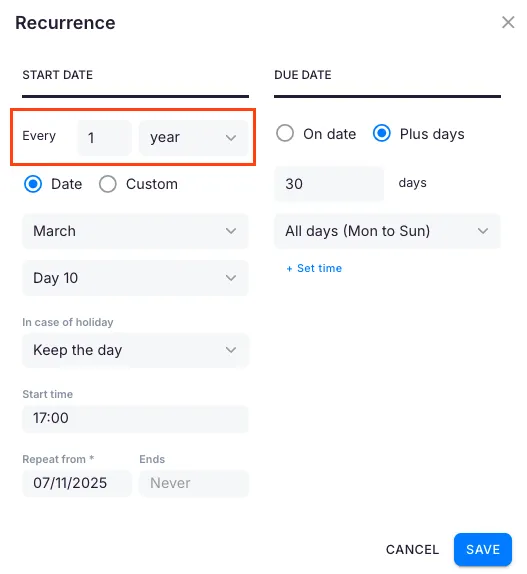
Section titled “Annual recurrence due dates”- Select the month and the day, using either a specific date (with day-off handling) or a plus-days calculation from a reference point.
- Set counting rules (business days vs. calendar days).
Setting a recurrence end date
Section titled “Setting a recurrence end date”To control when a recurring task stops generating:
- Open the recurring task.
- Navigate to the Recurrence settings.
- Set an End date for the recurrence.
- Save the changes.
This is useful for tasks tied to a fixed-term contract, such as monthly bookkeeping for a client contract running from January to September.
Troubleshooting
Section titled “Troubleshooting”Recurring task due date is not calculating correctly
Section titled “Recurring task due date is not calculating correctly”Check that you set the recurrence pattern first, then configured the due date. The due date options change based on recurrence type.
Tasks appear on weekends when they should not
Section titled “Tasks appear on weekends when they should not”Edit the task’s due date settings and select Monday to Friday, excluding public holidays in the counting rules. Also ensure the Before or After day-off handling is set correctly.
Task appears too early on the dashboard
Section titled “Task appears too early on the dashboard”Check the task’s start date, Repeats from date, and recurrence settings. Adjust the start date calculation to make tasks appear closer to their due date.
Task due on the 20th — how to move it earlier if the 20th is a weekend
Section titled “Task due on the 20th — how to move it earlier if the 20th is a weekend”Use the specific date selection (20th) with the Before option. This automatically moves weekend deadlines to the preceding Friday.